
GAN APIs.
Generative
by design.
Explore GAN APIs for synthetic data, image generation, restoration, video, and speech. Clear architectures. Honest trade-offs. Guides you can build from.

One model family.
Different engineering problems.
Start with what you need to generate. Then work through the inputs, constraints, and evidence that make the output useful.
Synthetic data
Design schemas, preserve useful relationships, and evaluate generated records before release.
Images & restoration
Generate, translate, enhance, and stylize with explicit controls and meaningful fidelity tests.
Video & speech
Make time, context, and component boundaries part of the engineering contract.
New to GAN APIs? Start at the boundary.Learn how checkpoints, request contracts, job states, and artifacts fit together.
Explore GAN API architectureBuild a contract.
Not a black box.
A useful API says what its model can do, what a request means, and how a caller can inspect the result. Make those decisions before the first deployment.
Define the modality, input limits, and intended use.
Version configurations and preserve evaluation boundaries.
Compare with a baseline and inspect the failures.
{
  "model_revision": "tabular-v1",
  "schema": "orders-v2",
  "row_count": 1000,
  "conditions": {
    "status": "completed"
  },
  "seed": 42,
  "output_format": "parquet"
}Less guesswork.
More useful questions.
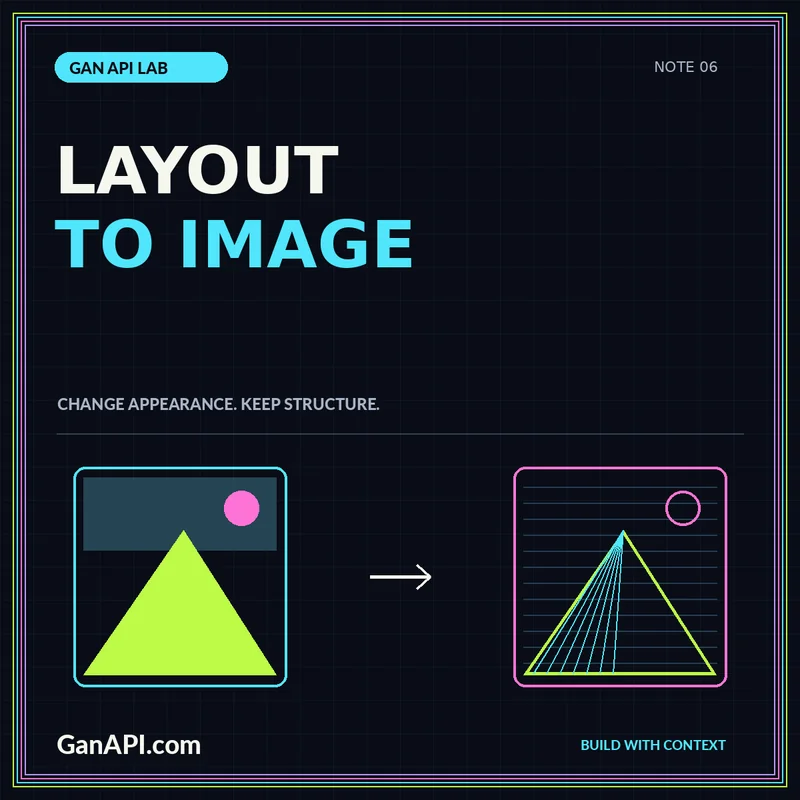
Image Translation and Semantic Layouts: Preserve What Matters
Compare image-to-image and layout-conditioned workflows, with explicit class maps, alignment rules, and preservation tests.
Read the guide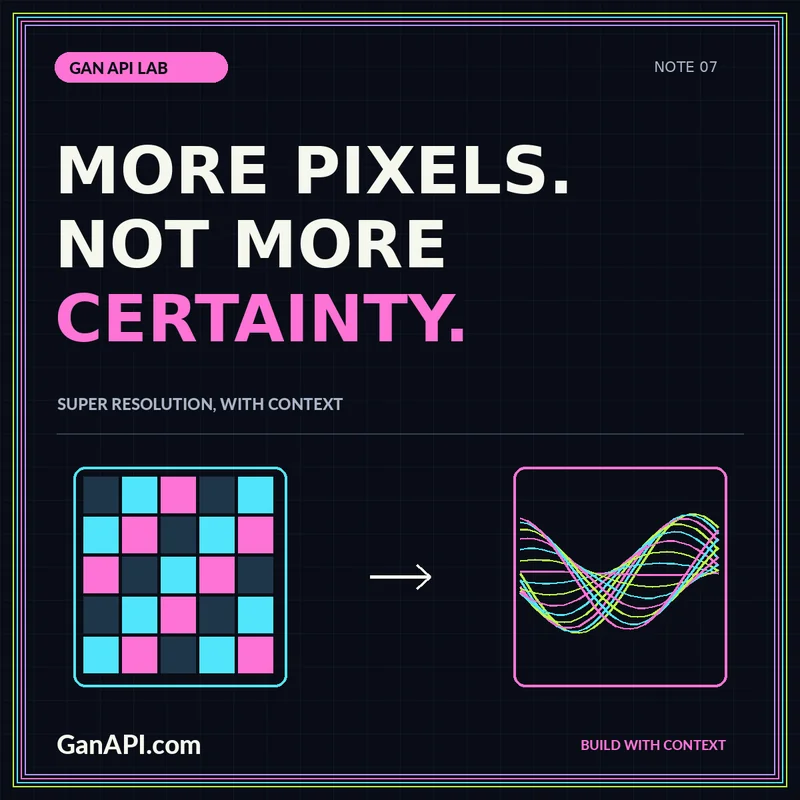
Super Resolution: Better-Looking Is Not Always More Faithful
Evaluate upscaling with honest baselines, realistic inputs, artifact review, and a clear distinction between inferred and observed detail.
Read the guide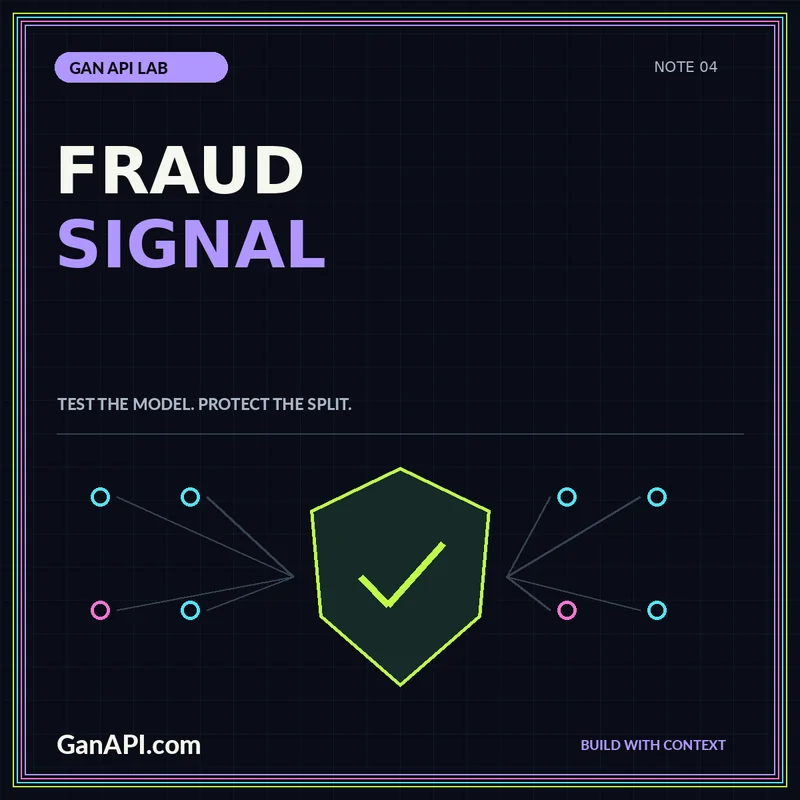
GANs for Fraud Detection: An Experiment Without Data Leakage
Design a defensive augmentation experiment with time-aware splits, fair baselines, and thresholds tied to a real review workflow.
Read the guideGood questions.
Clear starting points.
Get oriented before choosing a model, shaping a dataset, or exposing an interface.
What is a GAN API?
An interface around a generative adversarial model, with a defined input, output, and execution contract. Begin with the GAN API architecture pathway to distinguish model training from inference and artifact delivery.
Does GanAPI.com run models or issue API keys?
GanAPI.com is an engineering reference for AI engineers and product teams. Explore the guides, research context, and design patterns; this site does not issue API keys or execute generation jobs.
Which workflow should I explore first?
Choose the input and output you need. Start with tabular synthesis for records, image generation for latent sampling, or the video and speech pathways for sequences.
Are synthetic records automatically private?
Do not assume that they are. Utility and disclosure risk require separate evaluation for the actual source data and release context. Read the healthcare validation guide for a purpose-limited workflow.
How should a team compare GAN approaches?
Define the task, select a relevant baseline, protect the evaluation boundary, and inspect failure cases. The evaluation collection covers data validity, visual fidelity, temporal behavior, and practical acceptance decisions.
Make your next model decision count.
Start with the architecture. Follow the evidence. Keep the output in context.