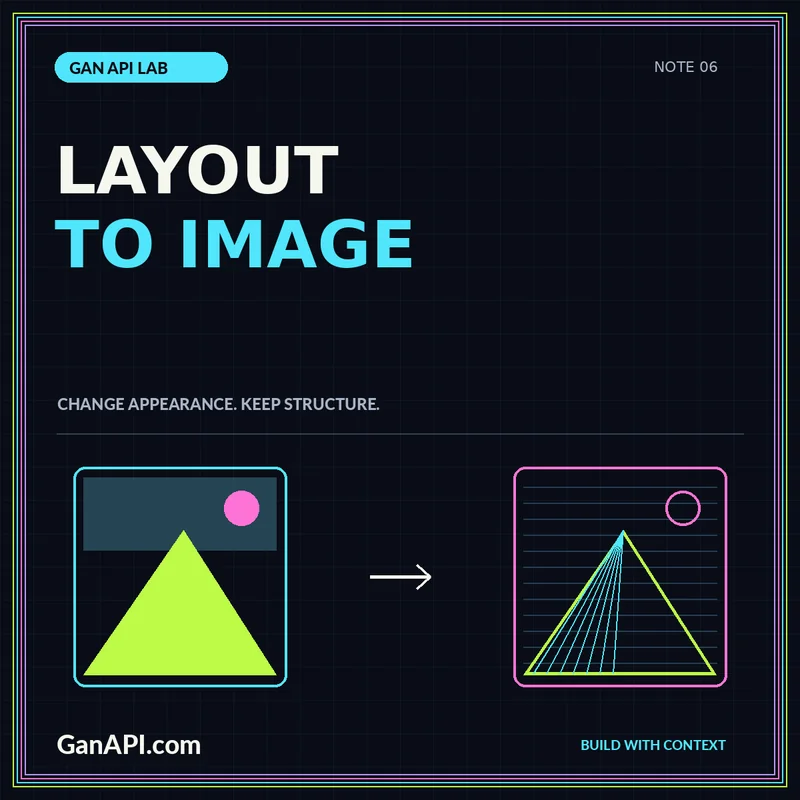
Image-to-image translation begins with a visual input, but that input can mean very different things. A photograph may supply appearance and structure. An edge map may describe boundaries. A semantic layout may assign a category to each region. A good API identifies which representation it accepts instead of describing every task as an image transformation.
This guide compares the design decisions behind ordinary image translation and semantic-layout synthesis. It proposes checks for alignment, class vocabulary, preserved content, and evaluation. Begin with the image-to-image translation pathway for source-to-target workflows, or the semantic image translation pathway when the caller supplies a structured scene layout.
Write down what is allowed to change
Define the target transformation in operational terms. A surface texture may change while object geometry should remain fixed. A scene layout may specify where categories appear while leaving local appearance flexible. A photographic domain adaptation task may need to preserve labels used by another model. These are different contracts, even when their outputs are all RGB images.
Create a preservation checklist before collecting examples. Identify boundaries, object counts, important text, colors, or regions that must remain unchanged. Also identify characteristics that the model is allowed to alter. Without that distinction, reviewers may reward attractive outputs that fail the intended task, and developers will have no consistent basis for comparing revisions.
Choose paired or unpaired data deliberately
A paired setup provides corresponding inputs and targets for the intended transformation. An unpaired setup provides collections from separate domains without one-to-one matches. The latter may be easier to assemble, but that convenience does not establish that the learned transformation will preserve the specific content your application cares about.
For either approach, inspect how data collection represents the intended use. Differences in camera position, cropping, lighting, or subject composition can become part of the learned mapping. If a model should change surface appearance, a dataset in which one domain contains systematically different objects creates a confounding problem. Document those differences before treating a translation as evidence of controlled behavior.
Treat semantic layouts as structured data
The SPADE research project describes synthesizing images from semantic layouts using spatially adaptive normalization. It illustrates why a label map is more than a colorful input picture: the semantic information is used to condition generation through the network. That principle should shape an API's validation and documentation.
Declare the permitted class vocabulary and how each class is encoded. If a visualization palette is provided for people, distinguish it from the machine-readable representation. A resized or recompressed colored preview should not silently become the authoritative label map. Store the class mapping with the model revision so the same integer cannot mean road in one release and water in another.
Preserve labels during preprocessing
Define resizing, padding, cropping, and orientation rules for each input type. An interpolation method suitable for photographs can create invalid intermediate class values in a categorical mask. Validate the decoded layout after every transformation. When instance identifiers or edge channels are required, check their shape and alignment rather than assuming that matching filenames establish correspondence.
Design a request that makes alignment inspectable
A useful request identifies the source artifact, transformation mode, model revision, output dimensions, and any supported conditioning input. Require explicit declarations for semantic maps and reference images rather than inferring their role from file extensions. Two PNG files may contain fundamentally different kinds of information.
Return a manifest that records the actual preprocessing applied. Include output dimensions and a reference to the input configuration so a reviewer can compare the result with the same crop and coordinate system. When input dimensions are unsupported, prefer an explicit error or a documented transformation over silent distortion. Surprising preprocessing can invalidate the entire evaluation while leaving the output visually convincing.
Evaluate structure separately from appearance
Build a held-out set containing ordinary inputs and difficult cases. For semantic synthesis, inspect whether categories occupy the requested regions and whether boundaries remain meaningful. For image translation, evaluate the preservation requirements chosen earlier. A plausible image that changes an important object is a failure even when its texture looks better than the baseline.
Use automated checks where they fit the task, but examine their limitations. A downstream segmentation model can offer one view of semantic alignment, yet its errors and training domain affect the result. Manual review can catch meaningful issues, but hand-picked examples introduce selection bias. Combine a repeatable sampling process with a rubric that names the required structure and allowed variation.
Do not combine every criterion into a single unexplained score. Report visual artifacts, layout adherence, content preservation, and downstream task behavior separately when those dimensions matter. A product team should be able to see which trade-off changed between revisions. Otherwise a small appearance gain can conceal a much more consequential loss of fidelity.
Handle uncertainty and unsupported inputs
A model may receive a scene arrangement unlike its training examples, an unknown class, or an incomplete layout. Define the expected response. Rejecting an unsupported class can be more useful than generating a confident-looking scene with an arbitrary substitution. Explain limits in the API contract so callers do not treat silence as compatibility.
If a model supports multiple outputs for one layout, represent them as alternatives rather than competing assertions about a true scene. Store the relevant random or style controls for each artifact. Diversity can be valuable for design exploration, but it should not obscure the requirement that all alternatives respect the same conditioning constraints.
Keep evaluation and use context connected
A translation that is acceptable for an illustration may not be acceptable for measurement, documentation, or analysis. Identify whether the output is intended as creative material, training augmentation, or a transformed record. For applications that depend on factual fidelity, require domain-specific evidence rather than assuming a perceptual review is enough.
Do not use a model's ability to change appearance as proof that it preserves identity, clinical information, or other sensitive attributes. Those are separate claims requiring appropriate evaluation and authorization. Keep original inputs available where permitted, identify generated outputs clearly in the receiving workflow, and avoid presenting them as untouched observations.
Plan performance around real image sizes
Benchmark the full input path, including decoding multiple aligned artifacts and storing the result. Measure representative aspect ratios, not only square examples. If tiling or patch processing is used, inspect seams and consistency across boundaries. Those artifacts may not appear in a small research sample but can dominate a large production image.
Set limits on input area, number of conditioning channels, and output count. Record the accepted request configuration in the job result. A team should be able to distinguish a model regression from an altered resize policy or unsupported input representation. Versioning the preprocessing contract is as important as versioning the weights.
Use a boundary case to test the contract
Choose a layout or source image with a thin object crossing an important boundary. Run it through the complete preprocessing and generation path, then inspect whether the feature remains aligned and recognizable. This can expose problems hidden by large, simple regions in a demonstration image.
Repeat the test at the largest supported dimensions and an unusual permitted aspect ratio. Keep the expected preservation rule unchanged. If the result fails, record whether the cause is input encoding, resizing, model behavior, or output assembly. A targeted case like this makes the contract easier to debug than another gallery of visually favorable samples.
Conclusion: an image is also a contract
A reliable translation interface states what its input represents, what may change, and what must remain intact. Semantic layouts add a structured vocabulary that deserves the same validation care as a database schema. Evaluate preservation and appearance independently, and keep the transformation visible to downstream users.
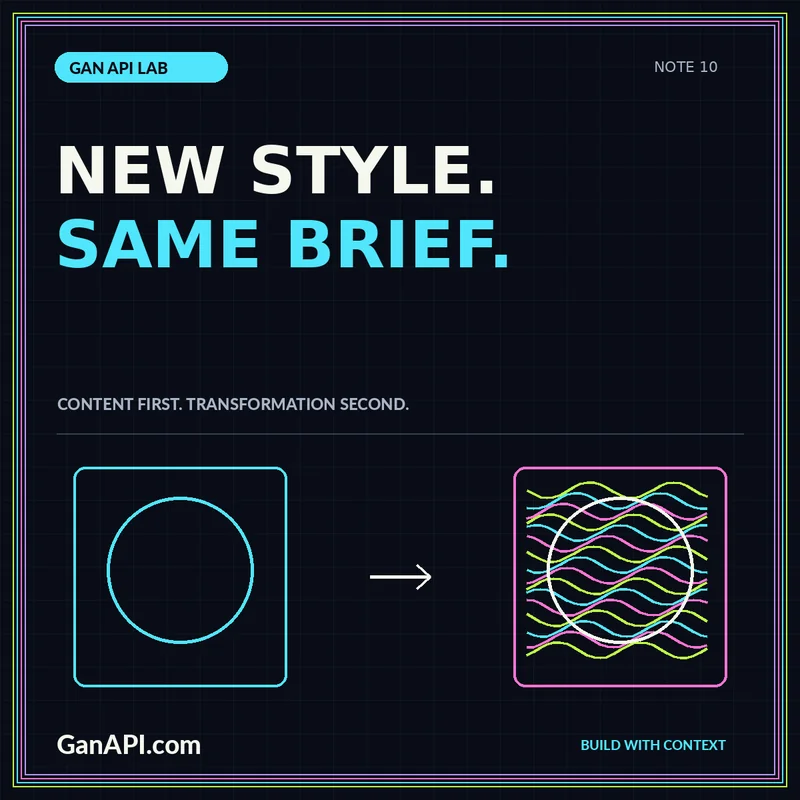
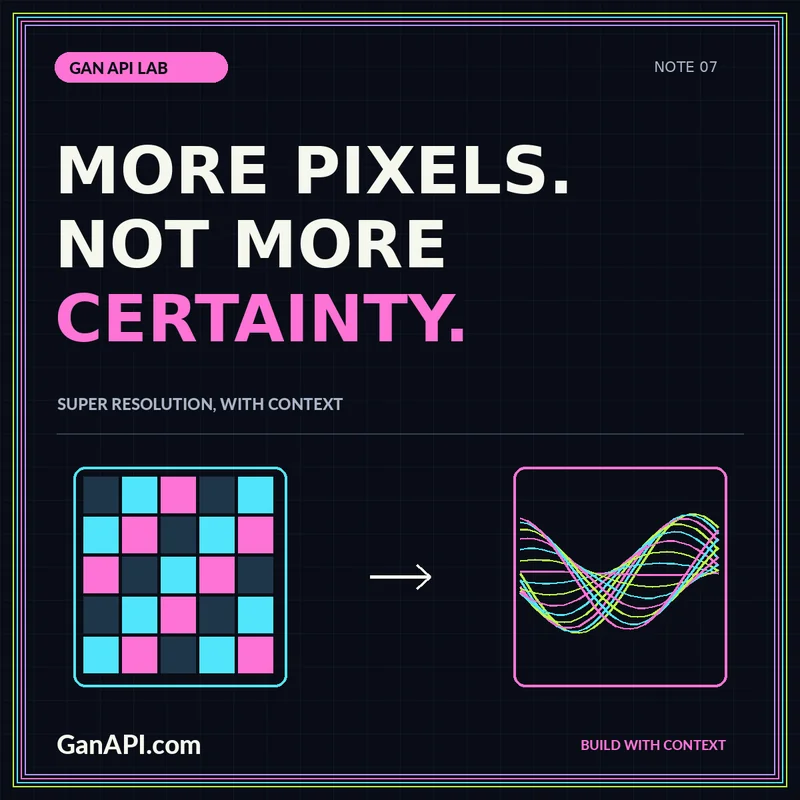
For a creative domain-mapping example, continue with the style transfer workflow. For a task where added pixels can create a misleading impression of recovered detail, read the super-resolution guide. The common discipline is to make the intended transformation testable rather than relying on an attractive before-and-after pair.