
Image-to-Image Translation GAN API
Change the intended appearance without losing the structure the application needs.
Specify what may change
Define the target transformation and its preservation requirements. Texture, color, geometry, object count, and important text may each need different treatment. An attractive target-domain image can still fail if it changes a property the application relies on.
Inspect whether your dataset provides paired examples or separate unpaired collections. Their availability and domain differences affect the experiment. The translation article below explains why a shared image file format does not establish equivalent input semantics.
Make preprocessing visible
Identify accepted input types, dimensions, orientation handling, and alignment rules. When reference images, masks, or other conditions are required, validate each representation explicitly. Avoid silently stretching or cropping an image in a way that undermines preservation tests.
Return the actual preprocessing configuration with the output. Version it alongside the model so reviewers can compare the same crop and coordinate system. An inference result without its transformation history is difficult to evaluate reliably.
Evaluate the transformed content
Compare appearance and preserved structure separately. Include difficult held-out examples and downstream checks when the output serves another model or workflow. Do not replace a systematic evaluation with a hand-picked before-and-after gallery.
For explicit class-map control, use the semantic image translation pathway. For domain stylization, read the style transfer guide. Choosing the right input representation is often more important than adding parameters to a broadly named endpoint.
Intent
A written change-and-preserve contract.
Alignment
Consistent coordinates and preprocessing.
Review
Appearance and structural fidelity measured separately.
Questions for this workflow
Are paired examples always available?
Not necessarily. Paired and unpaired setups are different experiment designs. Select one deliberately and evaluate whether the learned mapping preserves the required content.
Is image translation the same as super resolution?
No. Translation changes a representation or domain; super resolution increases spatial resolution and introduces its own fidelity questions.
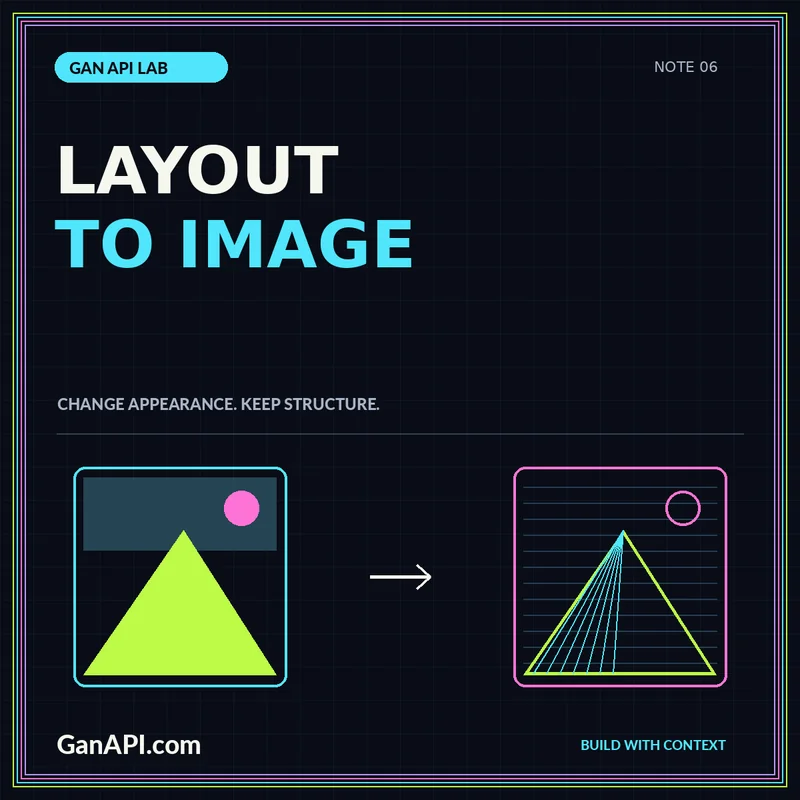
Image Translation and Semantic Layouts: Preserve What Matters
Compare image-to-image and layout-conditioned workflows, with explicit class maps, alignment rules, and preservation tests.
Read the complete guide