An image generation GAN API should make its controls understandable before it makes its outputs impressive. A caller needs to know whether the model accepts a random seed, a class label, a latent vector, a reference image, or some combination. These inputs are not interchangeable, and a control available in one architecture may have no meaning in another.
This guide proposes a practical interface for a bounded image-generation workload. It focuses on reproducibility, latent controls, domain coverage, evaluation, and output handling. It does not describe a hosted GanAPI.com generation service. Use the image generation GAN API overview to identify the intended workflow, then design the request around the capabilities of the actual checkpoint.
Start with the model's training domain
Specify what the checkpoint was trained to represent and where it should not be used. A model trained on a narrow visual collection should not be described as a general-purpose generator merely because it accepts random inputs. Ask whether the intended outputs resemble the training task and whether the available rights permit the planned use.
Create a domain card with supported categories, expected input controls, output dimensions, color handling, and known limitations. Avoid filling gaps with marketing language. An engineer integrating a model benefits more from a clear statement that it does not support text prompts than from an impressive but ambiguous invitation to create anything.
Distinguish a seed from a semantic instruction
A seed selects a pseudorandom starting point in a defined generation process. It does not, by itself, specify a composition, object, or style in human terms. A latent vector is the model's numerical input representation, while a class or other condition provides additional information only when the architecture and training support it.
The StyleGAN architecture paper describes a style-based generator with scale-specific control and a learned separation of aspects of variation. That research motivates careful exposure of model-specific controls. It does not mean every GAN offers the same disentanglement or that every latent direction corresponds to a stable, user-friendly concept.
Expose supported controls, not a generic options bag
Use fields that map directly to tested behavior. A seed, output format, checkpoint revision, and documented sampling parameter may be enough for an initial interface. Add advanced controls only after defining their ranges and failure behavior. Unsupported combinations should be rejected explicitly rather than ignored, because silent fallback makes integration tests misleading.
Decide what reproducibility actually means
A reproducible request needs more than a saved seed. Record the checkpoint, preprocessing and postprocessing revisions, relevant parameters, and execution configuration. Different numerical implementations or nondeterministic operations may affect exact outputs. Decide whether your promise is identical bytes, equivalent visual content, or simply a traceable procedure, then test that promise under the supported environment.
Store checksums for approved artifacts when exact assets matter. A product workflow that has approved one generated image should reference that artifact, not assume it can always recreate it later from a seed alone. Keep the generation record with the artifact so an editor or engineer can understand how it was produced and which model revision was involved.
Build a useful output manifest
An image response should identify the artifact and the information needed to consume it safely. Consider dimensions, media type, color space, byte size, checksum, generation parameters, and any review status used by the application. Keep a distinction between successfully writing an image file and determining that the image is suitable for publication.
Define how long outputs remain available and what happens when they expire. Avoid returning internal filesystem paths as if they were stable public resources. If a system uses temporary delivery URLs, document their lifetime and provide a safe recovery path. A downstream content pipeline should not discover that an approved asset disappeared only when a page is published.
Evaluate diversity and quality together
Review multiple random seeds and relevant conditioning settings rather than choosing a few attractive samples. Look for repeated structures, missing categories, visual artifacts, and failures concentrated in particular slices. A generator that produces one excellent example repeatedly may be less useful than one with slightly lower visual polish and much better coverage of the required task.
Compare against a baseline suited to the job. For a narrow texture library, a procedural method may already satisfy the brief. For a highly controlled design task, a deterministic rendering workflow may be easier to review. GAN generation is most useful when its flexibility addresses a real limitation of those alternatives, not merely because it introduces machine learning into the process.
Automated distribution metrics can support an evaluation, but keep their settings and reference data fixed across comparisons. Do not treat a single number as a universal measure of aesthetics, task suitability, or rights clearance. Combine systematic sampling with a review rubric that names the visual and functional requirements relevant to the actual application.
Separate creation, translation, and restoration
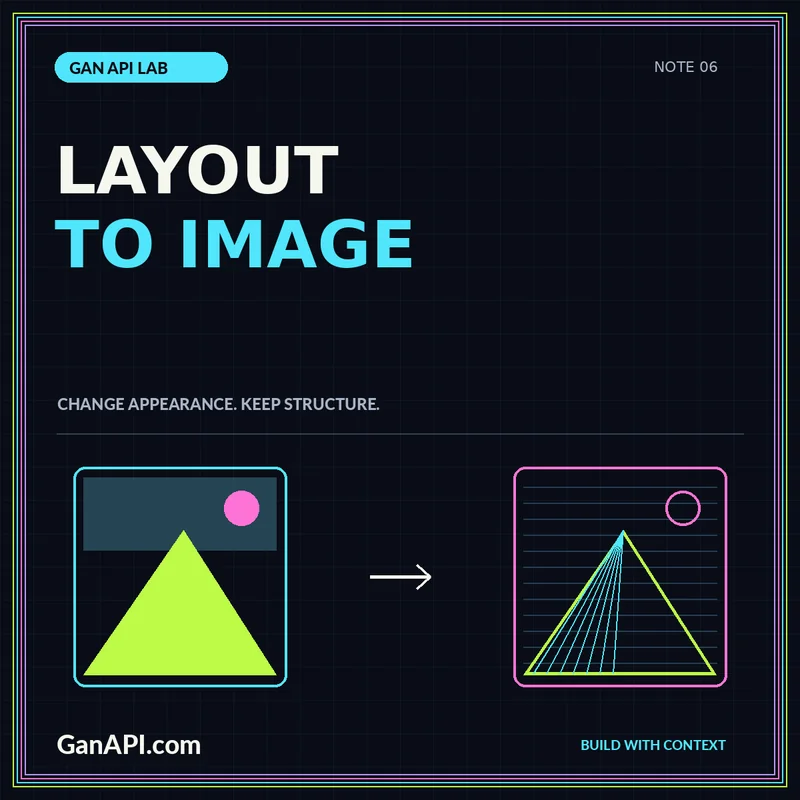
Generation from a latent input is different from changing an existing image or increasing its resolution. A product interface should make that distinction visible. Users who submit an image often expect its objects or layout to remain intact; a sampling endpoint with a loosely related reference control may not offer that behavior.
Route those tasks to dedicated designs. The image-to-image and semantic translation guide focuses on conditioning and preserved structure. The super-resolution fidelity guide addresses inferred detail and comparison with the original. Keeping the tasks separate makes evaluation more meaningful and prevents one successful demo from becoming an overly broad product claim.
Plan review and rights handling
Document the permissions associated with training data, model weights, reference inputs, and intended outputs. These are distinct questions and should not be collapsed into a single statement that the model is open source. Ask the responsible reviewer to examine the actual licenses and intended deployment rather than relying on the presence of a downloadable checkpoint.
For people, identities, and sensitive contexts, build consent and misuse controls into the workflow. Do not imply that a generated image documents a real event or represents a person's authorized endorsement. Keep provenance available to downstream teams and require appropriate review before publishing material that could mislead an audience about authenticity.
Measure the cost of accepted assets
Benchmark the full workflow at representative image sizes and batch settings. Include validation, queue delay, generation, encoding, storage, and review where applicable. Track rejected outputs separately. Cost per generated file can look attractive while cost per usable, approved asset remains high because many outputs need to be discarded or edited.
Set upper bounds on resolution, batch size, and retries. A consumer-facing workflow needs a clear outcome when the system cannot produce an acceptable result within those bounds. Avoid allowing a client to request unbounded repeated sampling until a subjective preference is met. That behavior makes both resource use and user expectations difficult to manage.
Make the first integration review concrete
Before expanding the interface, ask a client developer and an output reviewer to walk through the same request. The developer should understand its limits and failure states; the reviewer should understand the artifact’s origin and approval requirements. Compare their interpretations, especially around words such as random, reference, style, and deterministic.
Use that review to remove ambiguous controls and add missing manifest fields. A smaller contract that both roles interpret consistently is more useful than a large options list whose meaning depends on the person explaining it. Save one approved example and one rejected example with the reasons for each decision.
Conclusion: make each control earn its place
A useful image generation API exposes a narrow set of tested controls, preserves artifact provenance, and evaluates more than a showcase gallery. Start with the model's actual domain, state what reproducibility means, and distinguish file generation from publication readiness.
As the interface grows, require evidence for every new capability. A control should have a defined meaning, an allowed range, and an evaluation that demonstrates why it belongs. The GAN API architecture guide connects those choices to job states and output manifests, so a compelling image can also become a manageable part of a real engineering workflow.