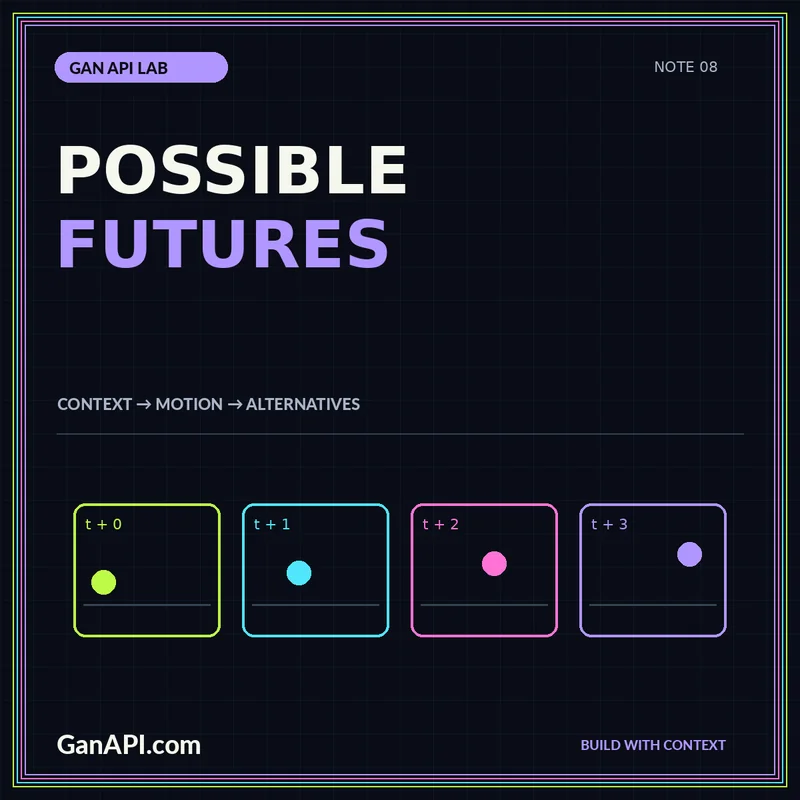
Video prediction estimates possible future frames from observed context. It does not observe the future, and a realistic-looking continuation should not be treated as evidence that an event will occur. For engineering teams, the central challenge is to represent that uncertainty while keeping the model's input assumptions, prediction horizon, and evaluation protocol visible.
A video prediction GAN API is therefore different from a general text-to-video product or a video interpolation tool. This guide proposes a research-oriented workflow for predicting continuations from a bounded context sequence. The video prediction GAN API pathway describes the service boundary; the decisions below explain what a meaningful evaluation should ask of it.
Define the prediction problem precisely
Specify how many context frames the model receives, their timing, the output horizon, and whether additional information such as actions is available. Frame count alone is not enough. Ten frames captured at one interval describe a different span of time from ten frames captured at another. Make timing part of the input contract.
Distinguish continuation from interpolation. Interpolation estimates frames between observations that are already available, while prediction produces frames beyond the provided context. Mixing these tasks can make an evaluation look stronger than the deployed problem. Also distinguish prediction from unconstrained generation, where a sequence may be judged creatively rather than against a particular observed history.
Understand why one future is not enough
The Stochastic Adversarial Video Prediction paper studies combining latent-variable and adversarial approaches to address realistic and diverse possible futures. Its motivation includes the ambiguity of predicting future observations. This is a useful starting point for designing outputs as conditional alternatives rather than a single certain forecast.
The paper's research setting does not establish the reliability of another model in a new environment. A deployment may involve different cameras, objects, actions, or motion. Document the conditions under which the checkpoint was trained and evaluated, and compare them with the intended input stream. Domain mismatch is an evaluation question, not a detail to hide behind a visually convincing example.
Build the dataset around independent episodes
Split at the level that prevents related clips from leaking across evaluation boundaries. Adjacent windows from the same recording can share nearly identical frames, even when they have different filenames. Consider episode, scene, camera, or time-period separation according to the question you need the test to answer.
Audit how clips were decoded and sampled. Frame-rate conversion, dropped frames, variable timestamps, and duplicate images can change the apparent motion. Keep a preprocessing manifest and verify it on representative inputs. A model evaluated on clean, regularly spaced frames may fail for reasons unrelated to its learned dynamics when a live stream supplies inconsistent timing.
Lock the context and horizon protocol
State exactly which frames are visible to the model and which frames are withheld for evaluation. Do not select a favorable starting point after reviewing the generated continuation. Use a fixed sampling protocol and record the horizon in both frames and elapsed time. This makes comparisons between model revisions understandable and reproducible.
Compare against simple temporal baselines
Include a baseline that repeats the last observed frame and, where appropriate, another simple motion-based prediction. Those baselines help reveal whether the candidate adds useful information beyond persistence. Evaluate them under the same context, horizon, resolution, and preprocessing settings. A complex model should earn its place through the intended task, not through model size.
Report performance as the horizon increases rather than collapsing every future frame into one average. A model may handle the immediate continuation while losing consistency later. Separate that pattern from occasional failures at the beginning. The distinction can guide a bounded deployment that permits only horizons supported by the evaluation.
Evaluate realism, consistency, and coverage separately
Inspect whether individual frames look plausible, whether objects and motion remain coherent across time, and whether sampled continuations cover meaningful alternatives. These criteria are related but not identical. Sharp frames can flicker; smooth sequences can be bland; diverse samples can violate the input context. Keep those failure types visible in the report.
For stochastic models, disclose how many samples are generated per context and how scores are aggregated. A best-of-many comparison gets more opportunities to match one observed future than a single-output baseline. Do not present those protocols as directly equivalent without explaining the difference. Evaluate the procedure that a real caller will actually use.
Use human review with a defined rubric and a repeatable sample-selection method. Reviewers should see the context sequence and know whether they are judging visual realism, temporal continuity, or adherence to a task. Randomize presentation where practical so preferred models are not advantaged by order or labels. Keep evaluation examples separate from promotional highlights.
Return alternatives with clear provenance
A proposed response can contain several continuation artifacts, each with its seed or latent configuration, timestamps, model revision, and context reference. Mark the generated interval separately from observed frames. A receiving interface should not splice both together without maintaining that distinction in the workflow's records and presentation.
Do not label a sample's rank as a probability unless the system has a justified probabilistic interpretation and appropriate evaluation. A generator's plausible alternative is not automatically a calibrated event forecast. State what a score measures and what it does not. Ambiguous confidence labels can create unwarranted certainty even when the underlying model is functioning as designed.
Avoid consequential claims from a visual demo
A continuation that looks reasonable in a research clip does not establish readiness for autonomous control, security judgments, or predictions about a person's behavior. Those applications require their own system-level evidence and safeguards. Keep the scope of a prototype narrow and make decisions about consequential use through the appropriate domain review.
For simulation or planning experiments, evaluate the downstream task directly rather than assuming visual quality proves utility. Record the state information available to the model and any assumptions about actions. A sequence can look realistic yet be unsuitable for the control or analysis objective that motivated the project.
Budget for sequences, not isolated frames
Measure the resource cost of context decoding, model execution, sampled alternatives, encoding, and delivery. Resolution, prediction horizon, and sample count all affect the size of the job, but their effect on runtime depends on the implementation. Use measured workloads rather than extrapolating from a single short clip.
Set limits on context duration, output horizon, resolution, and number of alternatives. Define timeouts and partial-result behavior. If one continuation succeeds and another fails, the manifest should describe that state explicitly. A completed job should not imply that every requested artifact passed the same checks when the service returned only a subset.
Plan for distribution changes
Keep a representative monitoring set and periodically examine whether incoming contexts still resemble the evaluated domain. Camera changes, new environments, different object speeds, and altered preprocessing can affect behavior. Record those changes so the team can distinguish a model issue from an input pipeline change.
Retain a rollback path and a policy for unsupported scenes. A system that knows only a narrow environment should not silently expand its claims because callers begin submitting new footage. Controlled rejection and a clear scope statement are preferable to realistic but unvalidated output that a downstream team mistakes for a reliable forecast.
Conclusion: predict possibilities, not certainty
A useful video prediction workflow states what was observed, what was generated, and how alternatives were evaluated. It uses independent episodes, honest baselines, horizon-specific reporting, and explicit sampling rules. That approach makes uncertainty part of the interface rather than a footnote beneath a compelling clip.
Continue with the GAN API architecture guide for job handling and provenance, and the image generation controls guide for seed and checkpoint decisions. The shared goal is an output that an engineer can inspect without mistaking plausibility for a guarantee about the world.